
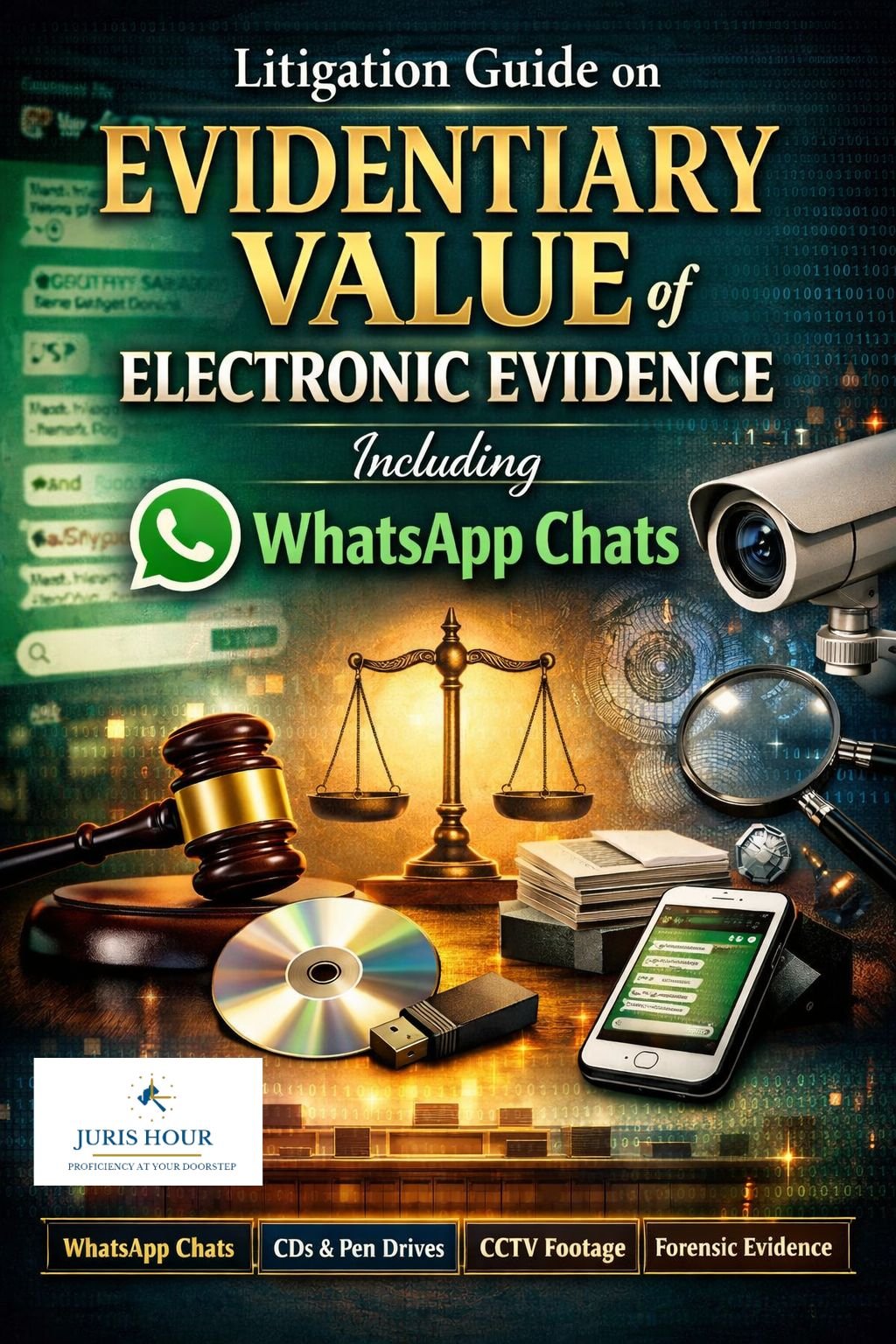
Litigation Guide on Evidentiary Value of Electronic Evidence Including WhatsApp Chats – BY ADVOCATE MARIYA PALIWALA
₹499.00 + GST
This e-book offers a clear, structured, and litigation-ready analysis of statutory provisions, landmark judgments, and emerging judicial trends relating to electronic evidence under the Indian Evidence Act, 1872 and the Bharatiya Sakshya Adhiniyam, 2023.
In an era where investigations, searches, and prosecutions increasingly hinge on digital footprints, the law governing electronic evidence has assumed decisive importance in litigation. Litigation Guide on Evidentiary Value of Electronic Evidence Including WhatsApp Chats is a comprehensive, practitioner-oriented guide that demystifies the evolving legal framework governing the admissibility, reliability, and probative value of electronic records in India.
This e-book offers a clear, structured, and litigation-ready analysis of statutory provisions, landmark judgments, and emerging judicial trends relating to electronic evidence under the Indian Evidence Act, 1872 and the Bharatiya Sakshya Adhiniyam, 2023. With a sharp focus on Section 65B of the IEA and its successor Section 63 of the BSA, the book explains how courts have consistently treated the certificate requirement as a condition precedent for admissibility, while also addressing the nuanced exceptions, controversies, and doctrinal debates that have shaped the jurisprudence.
A distinctive feature of this guide is its case-law driven approach. Each legal proposition is supported by carefully curated judicial precedents from the Supreme Court, High Courts, and Tribunals. Every case law cited in the book is hyperlinked to the original judgment copy, enabling readers to instantly access, verify, and rely upon authentic judicial records during arguments, drafting, or advisory work.
The book goes beyond theory to address practical litigation challenges, including:
Risks arising from non-compliance with mandatory certificate requirements
Distinction between curable procedural defects and inherent inadmissibility of electronic evidence
Electronic evidence collected during searches without presence of the assessee or without cross-examination of panch witnesses
Evidentiary limitations of data retrieved from personal devices of employees or third parties
Special emphasis is placed on WhatsApp chats, Call Detail Records (CDRs), CCTV footage, pen drives, CDs, computer printouts, and forensic reports, with dedicated chapters explaining when such evidence has been accepted by courts—and when it has been decisively rejected. The guide also examines the evidentiary value of electronic data in tax searches, DRI investigations, and GST proceedings, making it particularly relevant for indirect tax and economic offence litigation.
Written in a clear narrative style and supported by synoptic comparison tables, judicial extracts, and practical insights, this e-book serves as an indispensable reference for advocates, tax professionals, in-house counsels, adjudicating authorities, investigators, and law students.
Whether you are challenging electronic evidence or seeking to rely upon it, this guide equips you with the legal clarity, case law authority, and strategic understanding required to litigate confidently in the digital age.
INDEX
Introduction Electronic Evidence in the Digital Age
Statutory Framework Governing Electronic Evidence
Section 65B – Indian Evidence Act, 1872
Section 63 – Bharatiya Sakshya Adhiniyam, 2023
Section 79A of the IT Act, 2000
Comparative Analysis: Section 65B IEA vs Section 63 BSA
Certificate Requirement
Section 65B (IEA):
Section 63 (BSA):
Role of Experts
Synoptic Comparison Table
Evidentiary Significance of the Section 65B/63 Certificate
Early Judicial Approach
Settling the Law: Section 65B Declared Complete Code In Itself
Distinction Between Procedural Defects And Inherent Inadmissibility Of Digital Evidence
Certificate requirement & Judicial Controversy
Doctrine of Precedent and the Per Incuriam Debate
Restoration of Clarity On Certificate
Practical Litigation Perspective on Electronic Evidence
Risks Associated with Non-Compliance
Evidentiary Value of WhatsApp Chats, CDRs, CCTV & Forensic Reports
Tax Searches & Evidentiary Value Of Electronic Data
Electronic Evidence Can’t Be Rejected for Technical Non-Compliance of Section 138C of the Customs Act If Authenticity Is Admitted
Electronic Evidence Retrieved in Absence of Appellants and Without Cross-Examination of Panchas Is Inadmissible
Personal Electronic Devices Of Employees Or Third Parties Can’t Automatically Be Treated As Records Of The Assessee During Search
Evidentiary Value of WhatsApp Chats: CASE LAWS
- When WhatsApp Chats Are Admissible
- When WhatsApp Chats Are Inadmissible
Evidentiary Value of CD or pen drive: CASE LAWS
Unsealed Pen Drives & Non-Compliant Electronic Data Inadmissible as Evidence
Evidentiary Value of Printouts: CASE LAWS
Computer Printouts And Data Retrieved From The CPU Constituted “Electronic Evidence”
Admissibility Of Emails Copied Into DVDs During DRI Search: CASE LAWS
Manner Of Seizure Of Electronic Devices
Handling of Digital Data and Security of Personal Data
Handling of Seized Digital / Electronic Evidence
Chain of Custody and Integrity of Electronic Evidence
Procedure To Deal With Digital Evidence
Ensuring Integrity of Seized Digital Evidence – Write Blocking
Duplication of Evidence for Analysis – Acquisition Using Bit-Stream Technology
Authentication and Seizure of Digital Evidence – Mathematical Hashing
Limitations
Search and Seizure of Physical Evidence vis-à-vis Digital Evidence
Authority for Search and Seizure
Conventional Search of Physical Premises
Emergence of Digital Evidence in Search Operations
Application of Search Provisions to Digital Data
Similarity and Distinction Between Physical and Digital Searches
Search of Physical Assets and Documents
Search of Digital Devices
Key Differences Between Physical and Digital Searches
Conclusion: The Way Forward
Related Products
February 2026 Special Combo
Save37.3%Save ₹297.00Only₹499.00 Original price was: ₹796.00.₹499.00Current price is: ₹499.00. + GST📚 GST E-Magazine Mega Combo (11 Publications)
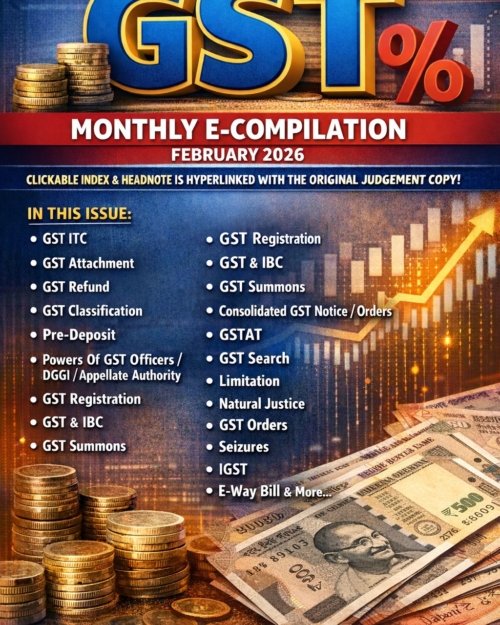
Save23%Save ₹1,640.00Only₹5,500.00 Original price was: ₹7,140.00.₹5,500.00Current price is: ₹5,500.00. + GST


Reviews
There are no reviews yet.